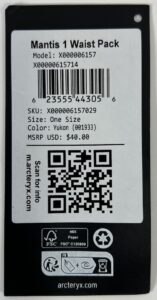
Arc'teryx Mantis 1

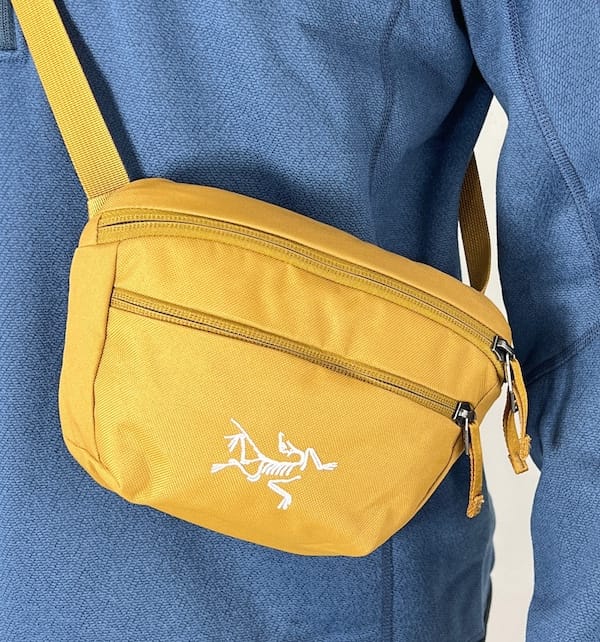
The Arc'teryx Mantis 1 weighs 165 grams, holds 1.5 liters, and measures 15cm x 21cm x 8cm. Arc'teryx designed this as a waist pack. I use it as a cable organizer. Two years in, it's the best tech pouch I've owned, and I didn't buy it for that purpose.
The 200D and 600D recycled polyester construction handles being tossed into checked luggage, dropped on wet airport counters, and crammed into the bottom of my Granville 16. FC0-DWR finish sheds light on moisture without perfluorinated chemicals. Price is $40, and it's available in Arctic Silk, Dynasty/Lodestar, Olive Moss, Soulsonic, Glacial, Rune/Tatsu, Tatsu/Canvas, Black, and Electra.
The Arc'teryx Mantis 1 as a Cable Organizer
The Mantis 1 has three zippered compartments that happen to separate cables perfectly. My main compartment holds an iPhone charging cable, a Garmin Watch charger, and a 20,000 mAh Anker power bank. The internal security pocket keeps USB-C cables and my wall adapter from tangling with everything else. The front pocket with its key clip stores USB adapters and earbuds.
Cables sit loose in each compartment rather than being held by elastic loops, which means it's less tidy than a dedicated cable roll but way faster to grab what I need. I don't want to unroll an entire organizer at an airport outlet. Unzip, grab, done.
Arc'teryx Mantis 1 vs. Dedicated Cable Organizers
The BAGSMART Electronics Organizer ($15-20) has elastic loops, mesh dividers, and purpose-built cable slots. It's better at keeping ten cables perfectly separated. The Mantis 1 doesn't try to do that. What it does is survive. BAGSMART pouches start to fray after 6 months of regular travel. The 600D polyester panels on the Mantis 1 show zero wear after two years.
Roll-up organizers like the ProCase pouch force you to lay everything flat and unroll the whole thing to reach a single cable. That's fine at a desk, but annoying during a layover when you need a charger. The Mantis 1's zipper access is much faster.
At $40, the Mantis 1 costs more than most cable organizers in the $10-25 range. The tradeoff is durability over organization. If you burn through cheap pouches every few trips, the math works out.
The Waist Strap Stays Attached
I leave mine attached. The adjustable strap runs 15 to 50 inches, which works around the waist or across the shoulder. It adds about 20 grams. I've used it exactly once as a waist pack on a day hike where I wanted quick access to my phone and power bank. Not worth removing for the negligible weight savings.
What Materials Does Arc'teryx Use?
Two different polyester weights handle different jobs. The main body is 200-denier DTY rePET plain weave, lighter and more packable. The bottom panel and stress points use 600-denier DTY rePET for abrasion resistance. Both are 100% recycled polyester, Bluesign-approved, and FC0-DWR-treated.
The Spacermesh back panel adds some ventilation if you're actually wearing this on your body. A rear stash pocket fits most phones, and transit passes flat against you. Fair Trade Certified production.
Worth $40 for Cables, Not Organization
For cable organization specifically, no. A $15 BAGSMART does that job better for a compact, durable pouch that keeps cables separated and survives years of travel abuse, yes. I pair this with the Mantis 2 as a dopp kit and the Index Gear Organizer as a packing cube. Three pieces that cover every small-item need in my bag. For a full rundown of Arc'teryx bags, check the backpacks guide.
Shop the Arc'teryx Mantis 1 at Arc'teryx or the BAGSMART Electronics Organizer at Amazon.